
Jewelry Styles, Traditions, Heritage?
- Barbara Behrens

- Sep 27, 2025
- 3 min read
Isn’t all jewelry that’s made by Native Americans the same? It’s just silver and turquoise, isn’t it? NO! There are actually over 300 different registered Native American Tribes in the United States, and they each have their own identity and traditions. There are 23 Indian tribes located in New Mexico - nineteen Pueblos, three Apache tribes (the Fort Sill Apache Tribe, the Jicarilla Apache Nation and the Mescalero Apache Tribe), and the Navajo Nation. Each of those tribes has their own rich history and way of life.

The first Native Americans began making jewelry thousands of years ago, with evidence of jewelry-making dating back to around 12,000 years ago. Various tribes across North America created jewelry using materials such as shells, stones, and bones. Other common materials included turquoise, coral, and silver, particularly among Southwestern tribes like the Navajo and Zuni. Culturally, jewelry served not only as adornment but also as a means of expressing identity, status, and cultural beliefs.

When European settlers, including the Spaniards, came to the Americas, they brought horses that were adorned with decorative bridles, these bridles inspired new styles of jewelry. Additionally, they brought silver and Native artisans started blending metals with their traditional designs. This merger created unique styles that blend their craftsmanship and traditions with creativity and carry them to new levels.
Each tribe developed their own style and developed skills that enabled them to showcase distinct jewelry-making techniques. Navajos mastered silversmithing, setting the stage for bold, eye-catching bracelets and concha belts. They also mastered the art of setting larger pieces of turquoise and other stones alongside intricate silver feathers or leaves. Navajo pieces are recognizable for the decorative silverwork that adorns each piece. Among the Navajo, silverwork stands out as a signature style. They became renowned for their use of silver, which they skillfully transformed into stunning pieces often adorned with turquoise. Hammering, stamping, and casting are all traditional methods that continue to be employed, each requiring precision and expertise developed over generations.


The Hopi learned to use silver in unique ways by creating designs that use layers of silver superimposed upon each other. Hopi jewelry is rich with imagery depicted in cutouts of overlay silver that tell stories within each piece.


The Zuni mastered another technique, stone inlay which can be channel or, cobblestone inlay, where artisans carefully fit stones together like pieces of a puzzle to create beautiful mosaics. This method produces intricate designs that can be incredibly detailed and often depict highly symbolic images.

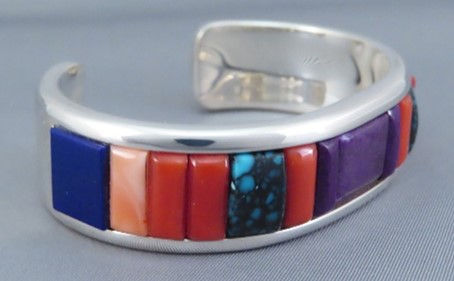

Current day Native American artisans often continue to innovate while paying homage to their ancestors’ traditions. Many of these artisans blend traditional techniques and symbols with new interpretations on design. In this way, they continue to share and respect their culture.
The use of shells, stones and bone to create beads which are then carefully cut, shaped, drilled is a finely honed skill among some of the pueblos in New Mexico. This type of bead is referred to as heishi. The meaning of heishi beads goes beyond their physical beauty. Traditionally, they hold spiritual significance for the Native American communities that create them. The origin of heishi beads can be traced back over a thousand years, making them one of the earliest forms of jewelry in the Southwest. Initially, these beads were created from natural materials readily available in the region, such as shells gathered from ancient seabeds or stones collected from nearby quarries.


So, when I said that the styles of Native American jewelry were different, I wasn’t kidding! I hope you now can see what I was referring to. What I have represented here is just a small sampling of some of the artistry of these incredible craftsmen. Their craftsmanship has been evolving over literally thousands of years.


Comments